


A Hair Loss Researcher Spent a Decade Finding a Better Finasteride (With Less Side Effects)
Most men only hear about the pill. The more interesting question is what happens when you take the same molecule and aim it at the one place that’s actually losing hair: your scalp.

Hair-loss researcher & patient advocate · Editorial board, top dermatology journal · 8 min read
If you’re a man watching your hairline go and weighing up what to actually do about it, you’ve probably run into the same wall everyone else does.
On one side, people telling you finasteride is a miracle and you’d be mad not to take it.
On the other, forums full of men saying the pill wrecked their libido, their mood, and their focus, and that for some of them it never fully came back.
“It works, but is it worth the risk?” “I want the hair, not the whole-body side effects.”
Both things can be true at once. Finasteride is one of the most effective hair-loss treatments we have. And a subset of men genuinely don’t like what the oral version does to the rest of their body.
I’ve spent over a decade in hair-loss research.
I sit on the editorial board of a top dermatology journal. I run the world’s largest hair-loss community. And my specialty is catching the flaws in studies that hide what treatments really do.
But there’s a version of this drug that far too few men understand properly:
The same drug, put on your scalp instead of swallowed, so it works mostly where the problem is and far less everywhere else.
That’s the case for topical finasteride and dutasteride. Let me walk you through it: how it works, what the research shows, and the honest catches.
First — what finasteride actually does
Here’s the part nobody explains to you properly.
Finasteride doesn’t ‘work on your scalp’ in the way most people picture it.
It blocks an enzyme in your body that converts testosterone into DHT, the hormone that slowly shrinks genetically sensitive hair follicles until they stop producing real hair.
The catch is that this enzyme isn’t only in your scalp. It’s in your skin, your liver, your prostate — all over your body.
So when you swallow the pill, you don’t just lower DHT on your scalp. You lower it everywhere: at the scalp, and just as much across the rest of your body.
Source — scalp DHT −64% and serum DHT −71% at 1 mg/day: Drake L, Hordinsky M, Fiedler V, et al. “The effects of finasteride on scalp skin and serum androgen levels in men with androgenetic alopecia.” J Am Acad Dermatol. 1999;41(4):550–554.
For most men, that whole-body change is uneventful. The large trials are clear that serious side effects are uncommon.
But not for everyone.
Some men are simply more sensitive to a drop in DHT. Lower it across the whole body, and it can hit their libido, erections, mood, or focus.
For a small number, those problems reportedly lingered even after they quit. It has a name some in the community use: post-finasteride syndrome, or PFS. Sexual, mood, and mental-clarity issues that hang on for months, sometimes years, after stopping.
The science isn’t settled. But for what it’s worth, I believe these men.
So, for men who are concerned about side effects, it begs the question: could you get the DHT blockade where your hair is, without changing the hormone in your entire body?
That’s exactly what putting it on your scalp is designed to do.
Topical finasteride: the same molecule, aimed at the target
The idea is simple. Put the drug where the hair is, and keep it off the rest of you.
Does that actually work, or is it just a nicer story? The head-to-head data are encouraging.
In a large trial, men using a finasteride spray grew about as much hair as men on the 1 mg pill.
The difference was in their bloodwork. The spray lowered the DHT in their blood by about a third. The pill lowered it by more than half.
Far less of the drug ended up anywhere but the scalp.
Source — serum DHT −34.5% (topical) vs −55.6% (oral), comparable hair count, >100× lower plasma exposure (n=458, 24 wks): Piraccini BM, Blume-Peytavi U, Scarci F, et al. “Efficacy and safety of topical finasteride spray solution for male androgenetic alopecia: a phase III, randomized, controlled clinical trial.” J Eur Acad Dermatol Venereol. 2022;36(2):286–294.
Read that together. About the same hair growth at the scalp, with far less of the drug reaching the rest of your body. That is the entire point of going topical.
And you can dial it in. Even a tiny daily dose can slow shedding and thicken hair, while barely touching the DHT anywhere else.
Cautious and low, or full strength? Your call. That flexibility is one of the things I like most about it.
Translation: the same proven DHT blockade that drives the pill’s results, concentrated on your scalp, with far less reaching the rest of your body.
Dutasteride: the stronger cousin, localised
If finasteride is the well-known name, dutasteride is the heavier hitter.
Finasteride blocks one form of that DHT-making enzyme. Dutasteride blocks both.
So it lowers DHT more completely. And head-to-head, it grows more hair.
Source — oral dutasteride 0.5 mg/day lowers DHT ~90%+: Ding Y, Wang C, Bi L, et al. “Dutasteride for the Treatment of Androgenetic Alopecia: An Updated Review.” Dermatology. 2024;240(5–6):833–843. Finasteride ~71%: Drake L et al., J Am Acad Dermatol. 1999;41(4):550–554.
Interestingly, despite that stronger effect, the research so far doesn’t show a clear jump in sexual side effects versus finasteride. Still, the more powerful the drug, the more some men understandably want to keep it off the rest of their body.
Same logic as before: take that stronger blockade and aim it at the scalp.
The early studies are promising. In one study, low-dose topical dutasteride (applied with microneedling) clearly outgrew the placebo group.
And the men in that study reported no sexual side effects — an early sign that, at these low strengths, it's staying where you put it.
The evidence here is still early compared to finasteride. But it’s encouraging, and the pattern is consistent: low strength holds the line, higher strength grows more hair.
Where you land comes down to dose and formula. Which is exactly why this is a conversation for a prescriber, not a guess.
Translation: the most complete DHT blockade we have, with the option to keep it local.
Source — microneedling plus low-dose (0.01%) topical dutasteride improved hair growth vs. placebo Sánchez-Meza E, Ocampo-Candiani J, Gómez-Flores M, et al. “Microneedling plus topical dutasteride solution for androgenetic alopecia: a randomized placebo-controlled study.” J Eur Acad Dermatol Venereol. 2022;36(10):e806–e808.
How the safety actually compares
This is the part that matters most, so I’m going to give it to you straight: the good and the caveats.
First, the good news.
In that same trial, the sexual side effects men worry about hit 2.8% of topical users, versus 4.8% on the pill. Roughly half the rate, and about the same as placebo.
Less drug in your blood, less chance of trouble elsewhere. That’s the whole trade.
Source — treatment-related sexual adverse events 2.8% (topical) vs 3.3% (placebo) vs 4.8% (oral): Piraccini BM, Blume-Peytavi U, Scarci F, et al. “Efficacy and safety of topical finasteride spray solution for male androgenetic alopecia: a phase III, randomized, controlled clinical trial.” J Eur Acad Dermatol Venereol. 2022;36(2):286–294.
Now the honest caveat. You’ll hear the occasional horror story about topical finasteride too.
Look closely, and it’s almost always the same culprit: dose.
Some companies sell it at 0.3%, 0.5%, even 1%, far stronger than what most studies have tested. And here’s what the marketing won’t tell you: stronger doesn’t grow more hair. The benefit plateaus.
All that extra strength does is push more drug into your blood, raising the odds of the exact side effects you went topical to avoid.
So the honest takeaway isn’t ‘topical is risky.’ It’s this: ‘lower’ is not ‘none,’ and dose is the dial. A well-formulated product at a sensible, studied strength behaves like a local scalp treatment. An over-concentrated compound applied by the bucketload starts behaving like an oral drug. Same active ingredient, completely different risk profile.
That’s the whole case for doing this properly: a precise, localised dose, not a unnecessary mega-strength formula.
The playbook is simple, and it works:
- Start at the lowest dose that does the job.
- Pick a formula built to stay in the follicle, not blast through your skin.
- Get a baseline DHT blood test, then retest a month later, so you can see for yourself how little reaches your blood.
- If your blood work shows a big drop in DHT but you feel totally fine, you’re one of the 90%+ of men who handle a DHT drop without trouble. Now you can push the dose higher and capture bigger hair gains (up to a point).
Precision, not brute force. That’s what makes a localised approach shine.
Why the localised approach is worth understanding
Step back and the logic is hard to argue with.
Your hair loss is happening in one place. The pill treats it by changing a hormone everywhere.
Topical finasteride and dutasteride close that gap. The DHT blockade goes where the follicles are, and the rest of you stays largely out of it.
You also get a dial:
- Cautious? A low-dose topical steadies the loss while barely reaching the rest of you.
- Want maximum regrowth? Go higher strength, or step up to dutasteride, with a clearer conversation about how much reaches your blood.
And it stacks well with the other things that actually help, like minoxidil or microneedling.
None of this is a prescription from me. Whether any of it fits you is a call for you and a licensed provider. But of everything in the ‘fewer side effects than the pill’ category, this is the approach with the most actual evidence behind it.
The one I helped build
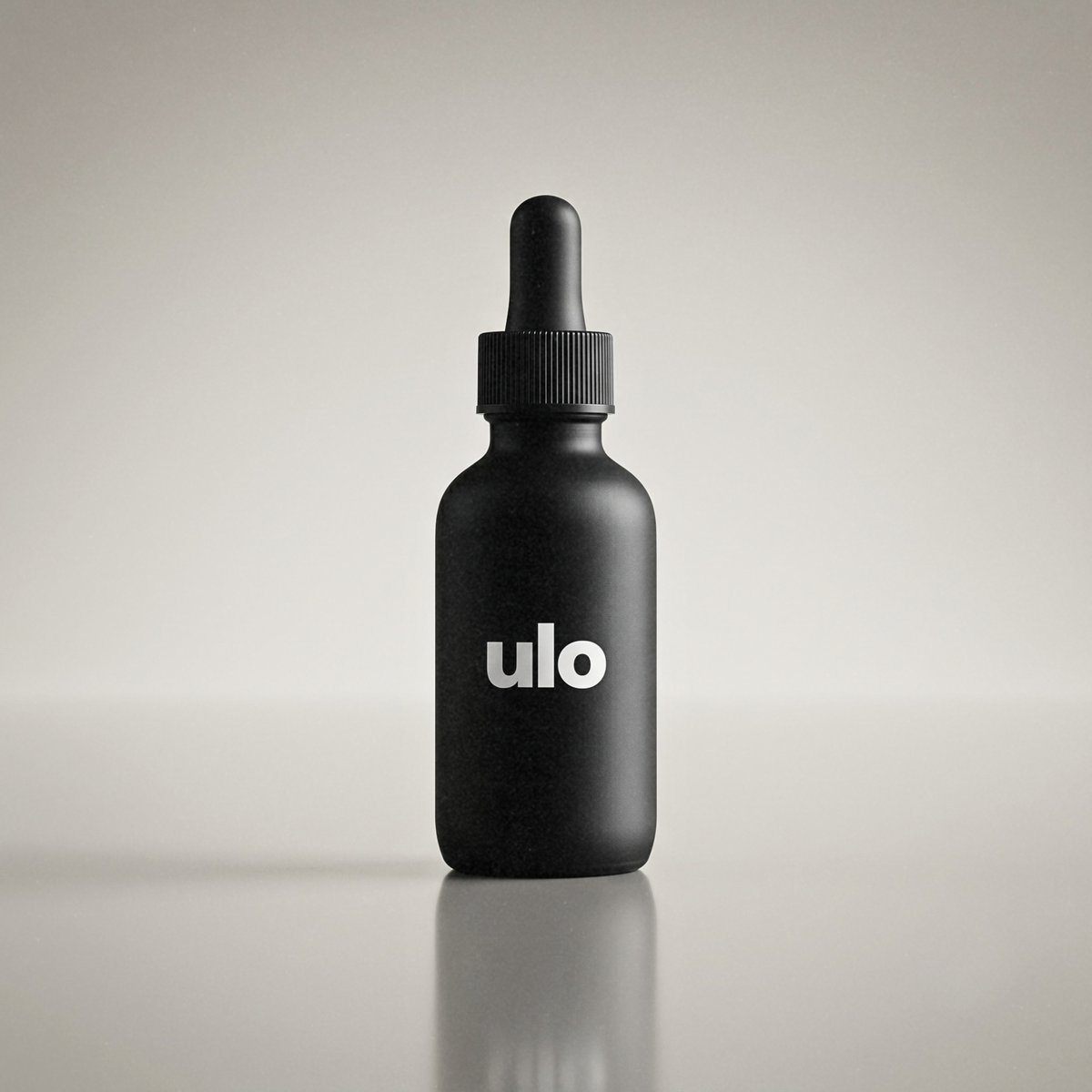
Full disclosure: I co-founded Ulo.
After a decade of uncovering why so many treatments fall short, I wanted to provide a real solution. Something better than the oral pill, built on the best clinical evidence we have.
So we built it. Topical finasteride and dutasteride, from low dose to full strength, prescribed and guided by a licensed provider.
At Ulo, we demanded more — rigorous standards for formulation and ingredient selection, safer formulas, and a relentlessly evidence-based philosophy.
It’s why we back it with a real guarantee. For the first time, men in the US can go after this problem in a way they can feel confident.
Don’t take my word for it
Here’s what’s happened for men who wanted the results without dosing their whole body.
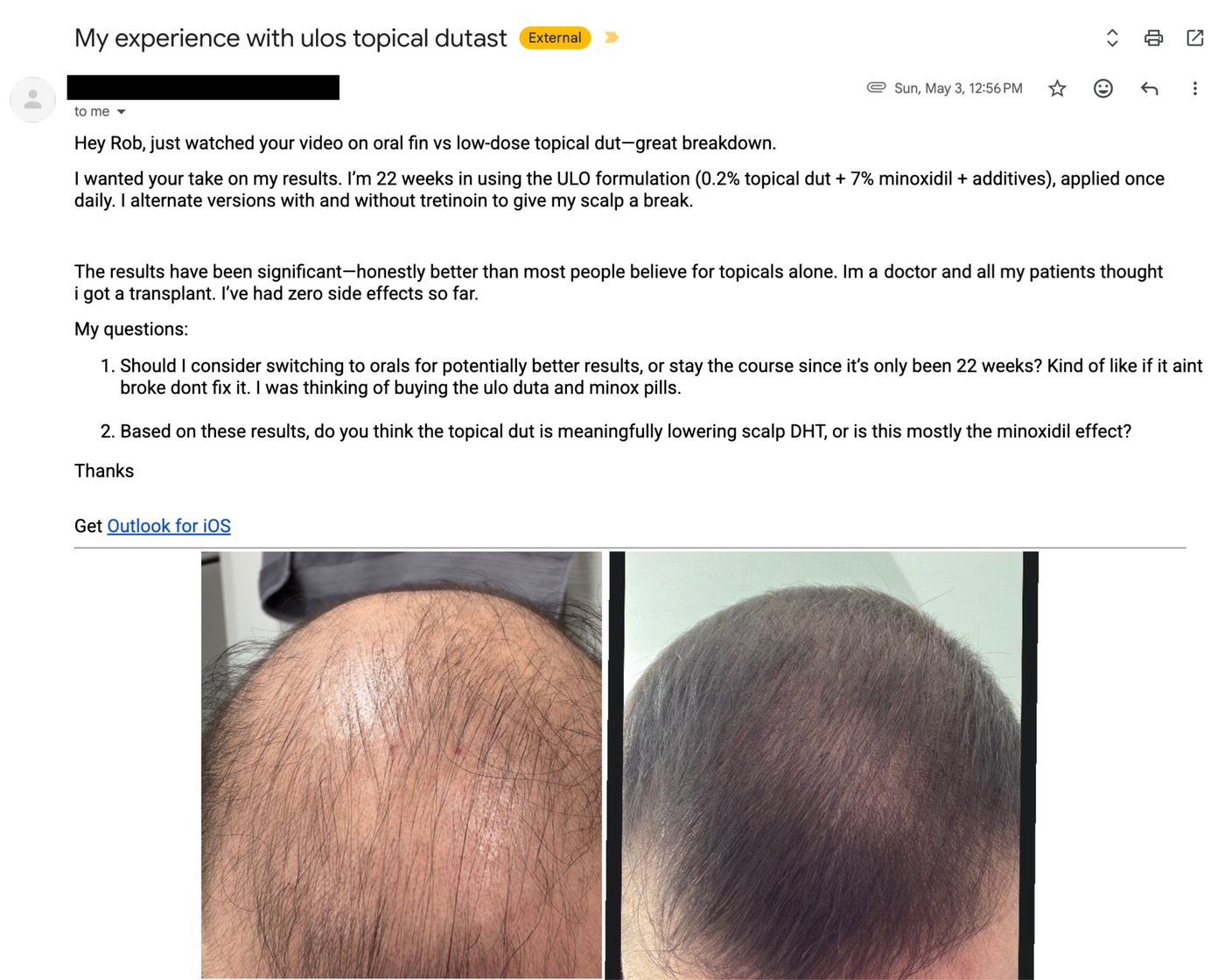

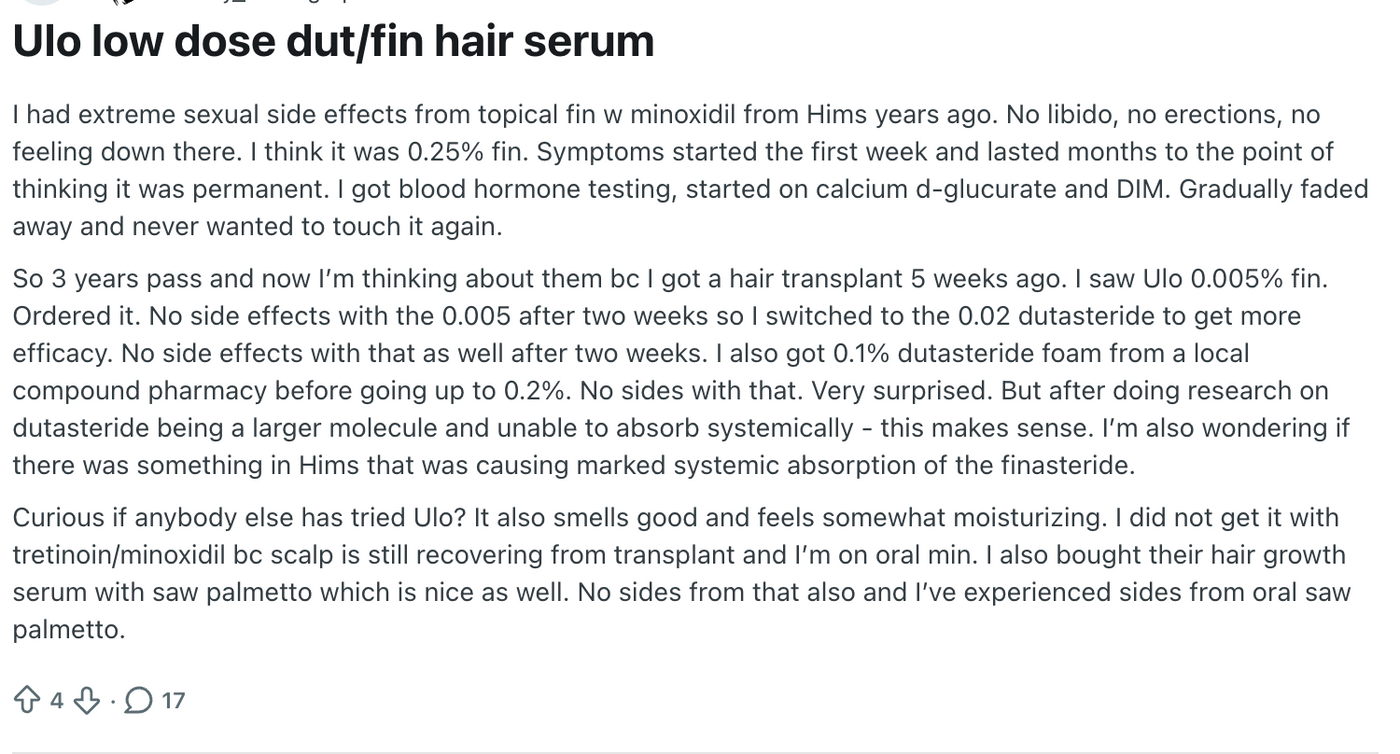


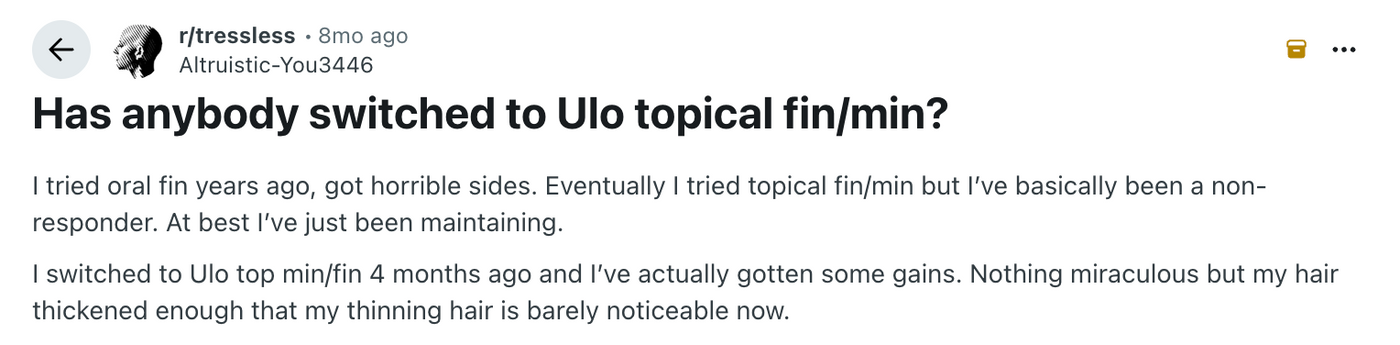





Results vary, and no honest program will promise you a specific outcome.
But these men stopped treating ‘the pill or nothing’ as their only two choices.
Where this leaves you
If you’ve been stuck between “take the pill and hope” and “do nothing and watch it go,” there’s a middle path a lot of men never hear about.
The same finasteride, aimed at your scalp instead of your whole body. And if you want to push harder, dutasteride done the same way.
It’s not magic, and it’s not risk-free. But used sensibly — low dose, good formulation, a provider watching your numbers — it’s the most evidence-backed way to go after the problem locally.
That’s the option that was on the table the whole time.
See the options and the full evidence
Topical finasteride and dutasteride, low dose to full strength, prescribed and guided: the DHT blockade where your hair is, not through your whole body.
If you scrolled: the oral pill lowers DHT everywhere in your body, which is why a minority of men dislike it. Topical finasteride puts the same effect on your scalp. In a large trial it matched the pill for hair growth while lowering the DHT in the bloodstream far less, and sexual side effects were about half as common. Dutasteride is the stronger version and can be aimed at the scalp the same way. The honest caveat: less of the drug in your blood isn’t none of it, so the dose, the formula, and a prescriber all matter. Used well, it’s the most evidence-backed way to fight hair loss right where it’s happening instead of all over your body.
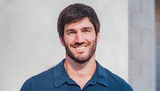
Rob English is a hair-loss researcher, published author, and patient advocate. He sits on the editorial board of a top-quartile dermatology journal and runs the world's largest hair-loss community — where his specialty is spotting the flaws in clinical trials that hide what treatments really do. After a decade of calling out what doesn't work, he co-founded the brand behind these topical treatments to give men an evidence-based alternative to the oral pill.

